
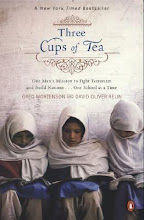
I hope you're enjoying Three Cups of Tea. I also hope that you got your tickets to see Greg Mortenson at Xavier University on September 29. There are no more tickets available for that event.
Let's get the discussion started!
-There is a telling passage about Mortenson’s change of direction at the start of the book: “One evening, he went to bed by a yak dung fire a mountaineer who’d lost his way, and one morning, by the time he’d shared a pot of butter tea with his hosts and laced up his boots, he’d become a humanitarian who’d found a meaningful path to follow for the rest of his life.” What made Mortenson particularly ripe for such a transformation?
-Relin gives a “warts and all” portrait of Mortenson, showing him as a hero but also as a flawed human being with some exasperating traits. Talk about how Relin chose to write about Mortenson’s character—his choice of details, his perspective, the way he constructs scenes. Is Mortenson someone you’d like to get to know, work with, or have as a neighbor or friend?
-At the heart of the book is a powerful but simple message: we each as individuals have the power to change the world, one cup of tea at a time. Yet the book powerfully dramatizes the obstacles in the way of this philosophy: bloody wars waged by huge armies, prejudice, religious extremism, cultural barriers. What do you think of the “one cup of tea at a time” philosophy? Do you think Mortenson’s vision can work for lasting and meaningful change?
-The Balti people are fierce yet extremely hospitable, kind yet rigid, determined to better themselves yet stuck in the past. Discuss your reactions to them and the other groups that Mortenson tries to help.
-Much of the book is a meditation on what it means to be a foreigner assimilating with another culture. Discuss your own experiences with foreign cultures—things that you have learned, mistakes you have made, misunderstandings you have endured.
-Did the book change your views toward Islam or Muslims? Consider the cleric Syed Abbas who implores Americans to “look into our hearts and see that the great majority of us are not terrorists, but good and simple people.” Discuss this statement. Has the book inspired you to learn more about the region?
Showing posts with label discussion questions. Show all posts
Showing posts with label discussion questions. Show all posts
Friday, August 20, 2010
Friday, July 23, 2010
Let’s Discuss Sweetness at the Bottom of the Pie!
Here are some discussion questions for you to think about. Please share what you thought about the book! Hope you’ve enjoyed this book as much as I have.
With her high level of knowledge, her erudition and her self-reliance, Flavia hardly seems your typical eleven-year-old girl. Or does she? Discuss Flavia and her personality, and how her character drives this novel. Can you think of other books that have used a similar protagonist?
With her excessive interest in poisons and revenge, it’s no surprise that Flavia is fascinated, not scared, as she watches the stranger die in her garden. In your view, is her dark matter-of-factness more refreshing or disturbing?
Flavia reminds us often about Harriet, the mother she never knew, and has many keepsakes that help her imagine what she was like. Do you think the real Harriet would have fit into Flavia’s mold?
Flavia’s distance from her father, the Colonel, is obvious, yet she loves him all the same. Does their relationship change over the course of the novel in a lasting way? Would Flavia want it to?
Like any scientist. Flavia expects her world to obey certain rules, and seems to be thrown off kilter when surprises occur. How much does she rely on the predictability of those around her, like her father and her sisters, in order to pursue her own interests (like solving the murder)?
Discussion questions are from the book’s publisher Random House.

Thursday, May 20, 2010
Discussion Questions for The Lost City of Z*
I hope you're enjoying The Lost City of Z! Without giving too much away, here are a few discussion questions for you to consider. Post a comment about them or just tell us what you think about the book--we would love to hear from you!
How would you describe Fawcett? A rational man of science? A victim of his own obsession? What were his most admirable qualities and what aspects of his character were most troubling?
Does the interweaving of Grann's own story of his search for the truth about what happened to Fawcett add to or detract from The Lost City of Z?
What does The Lost City of Z reveal about the nature of obsession? Why were people fascinated by Fawcett in 1925? Why are people still fascinated by him 85 years after his disappearance?
Does The Lost City of Z remind you of any other books you have read, either fiction or non-fiction?
*Discussion questions courtesy of litlovers.com, murmur.com, and me!
Thursday, January 14, 2010
Let's Get the Discussion Started!

I hope you're enjoying January's Featured Book of the Month, Farewell, My Subaru by Doug Fine. I'm sure you have lots of thoughts about the book, so let's get the discussion started!
-What do you like about the book? What don't you like?
-What steps have you taken to lead a greener lifestyle? Would you go as far as raising goats and driving a ROAT (Ridiculously Oversized American Truck) powered by vegetable oil?
-Do you think it's really possible to live a green lifestyle without giving up your modern conveniences? Why or why not?
Tuesday, December 15, 2009
Discussion Questions for Under the Banner of Heaven
 I hope you're enjoying our December Featured Book of the Month, Under the Banner of Heaven: A Story of Violent Faith by Jon Krakauer. Some insightful comments about the book have already been posted, so here are a few discussion questions for you to consider. Join the conversation or add your own thoughts...we'd love to hear from you!
Did you like the book? Why or why not?
Given the nature of--and the motive for--the murders of Brenda Lafferty and her child, should Ron Lafferty be considered mentally ill? Or, as Krakauer states in his book, "If Ron wasn't insane--or at least no more "insane" than anyone else who believes in God--what was he? Why had the Lafferty brothers' religious beliefs turned them into ruthless killers?"
How would you expect maintream and fundamentalist Mormons to react to Krakauer's book?
Monday, August 17, 2009
Discussion Questions for The Other
I hope you're enjoying The Other. Let's get the discussion started!
1. Neil describes John William at sixteen as “The rich kid who hates and loves himself equally. The contrarian who hears his conscience calling in the same way schizophrenics hear voices, so that, for him, there’s no not listening”. Have you encountered people like John William in your own life? In literature? What makes him a believable character, rather than a stereotype?
2. Does Neil also represent a familiar type or character? What makes him interesting or appealing to you? To John William? What distinctive characteristics (strengths and flaws alike) inform the way he tells John William’s story? Consider the qualities that Neil admires in John William in contrast to how he describes himself.
Friday, February 20, 2009
A Few More Discussion Questions for The Soloist
Music is a powerful presence in the book. For Nathaniel, the music he plays seems to help him keep his illness at bay. Do you believe there is a link between creativity and mental health or mental illness?
A visit from his sister is a joyful moment for Nathaniel, but her court appeal to manage his finances sets off his rage. (p. 240) Discuss what Steve and his readers know about Nathaniel’s family. Do you believe that family dynamics play a role in mental illness? If you know a family dealing with mental illness, how has that changed your preconceptions?
At one point in the book, Steve asks, “Is he happy?” (p. 126) What constitutes happiness for Nathaniel? How does asking this question help Steve to help Nathaniel? Do you think the book has a “happy ending?”
In what ways does Nathaniel's story fit your preconceptions about people facing homelessness, and in what ways has it changed your ideas? In what ways does his story fit your preconceptions about people facing serious mental illnesses, and in what way has it changed your ideas?
More discussion questions can be found in the On the Same Page website.
Friday, February 13, 2009
Let's Get Started: Discussion Questions for The Soloist
1. When they meet, Steve sees Nathaniel simply as a newspaper story, one that can bring attention to LA’s Skid Row. What obligations does Steve have—to his paper, to society, to Nathaniel—in reporting that story? How does his role change once the story affects Nathaniel’s life?
2. Readers begin to donate instruments and money immediately after Steve’s first article. What do you think compels people to help a stranger? Would people have been as eager to help Nathaniel if Steve hadn’t written about him or if Nathaniel had not been a musical genius? What do you think this says about human nature?
3. Although Steve doesn’t approach Nathaniel looking for either a friend or a music teacher, he winds up with both. Discuss how their relationship progresses from writer/subject to friendship. Is there a turning point in their relationship that you can identify? Have you experienced something similar in your own life?
Monday, January 12, 2009
More Discussion Questions for The Life and Times of the Thunderbolt Kid
I hope you’re enjoying our Featured Book of the Month selection. Here are a few more discussion questions for you to consider. Join the conversation and tell us what you think!
Bryson paints the 1950’s as an innocent, almost idyllic time. Was it?
Which of the people Bryson introduces in his memoir would you most like to meet or spend time with? Were there any who particularly reminded you of someone you knew when you were younger?
If you were to assume an identity as a superhero, what would your powers be?
Discussion questions courtesy of www.litlovers.com, the Madison Public Library, and the Twin Falls Public Library
Friday, January 2, 2009
Let's Get Started: Discussion Questions for The Life and Times of the Thunderbolt Kid
What is one of your favorite (or funniest) memories from childhood? Do you have any memories that are similar to Bryson’s?
What was your impression of Bryson’s father and mother?
Have you read any of Bryson’s travelogues? Do you prefer his travel writing or his memoir? Why?
What was your impression of Bryson’s father and mother?
Have you read any of Bryson’s travelogues? Do you prefer his travel writing or his memoir? Why?
Special thanks to the Madison Public Library in Madison, Wisconsin and the Twin Falls Public Library in Twin Falls, Idaho for sharing some of their discussion questions with us.
Monday, December 29, 2008
Coming Soon - Discussion Questions
I hope you enjoy The Life and Times of the Thunderbolt Kid. I'll be posting some discussion questions soon, so stay tuned!
Subscribe to:
Posts (Atom)

 Posts


