Wednesday, September 1, 2010

About Confessions of an Ugly Stepsister


September's Featured Book of the Month is Confessions of an Ugly Stepsister by Gregory Maguire. If you thought you knew the tale of Cinderella, wait until you read the story of Iris, one of the "less attractive" step-sisters in this revised version of the fairy tale. Set in 17th-century Holland, Iris and her family experience a mixture of hardships and happiness as they move from the poor streets of Haarlem to the homes of the elite. In the end, Maguire challenges readers to think about beauty and ugliness, and who the real heroine of this fairy tale should be.

Let us know what you think! Pick up a copy at your local library or place a copy on hold through our catalog. You can also meet Gregory Maguire on Tuesday, September 21st in the Main Library Reading Garden Lounge.

Friday, August 20, 2010

Let's Discuss Three Cups of Tea

I hope you're enjoying Three Cups of Tea. I also hope that you got your tickets to see Greg Mortenson at Xavier University on September 29. There are no more tickets available for that event.

Let's get the discussion started!

-There is a telling passage about Mortenson’s change of direction at the start of the book: “One evening, he went to bed by a yak dung fire a mountaineer who’d lost his way, and one morning, by the time he’d shared a pot of butter tea with his hosts and laced up his boots, he’d become a humanitarian who’d found a meaningful path to follow for the rest of his life.” What made Mortenson particularly ripe for such a transformation?

-Relin gives a “warts and all” portrait of Mortenson, showing him as a hero but also as a flawed human being with some exasperating traits. Talk about how Relin chose to write about Mortenson’s character—his choice of details, his perspective, the way he constructs scenes. Is Mortenson someone you’d like to get to know, work with, or have as a neighbor or friend?

-At the heart of the book is a powerful but simple message: we each as individuals have the power to change the world, one cup of tea at a time. Yet the book powerfully dramatizes the obstacles in the way of this philosophy: bloody wars waged by huge armies, prejudice, religious extremism, cultural barriers. What do you think of the “one cup of tea at a time” philosophy? Do you think Mortenson’s vision can work for lasting and meaningful change?

-The Balti people are fierce yet extremely hospitable, kind yet rigid, determined to better themselves yet stuck in the past. Discuss your reactions to them and the other groups that Mortenson tries to help.

-Much of the book is a meditation on what it means to be a foreigner assimilating with another culture. Discuss your own experiences with foreign cultures—things that you have learned, mistakes you have made, misunderstandings you have endured.

-Did the book change your views toward Islam or Muslims? Consider the cleric Syed Abbas who implores Americans to “look into our hearts and see that the great majority of us are not terrorists, but good and simple people.” Discuss this statement. Has the book inspired you to learn more about the region?

Wednesday, August 11, 2010

About Greg Mortenson and David Oliver Relin


Greg Mortenson

Greg Mortenson is the co-founder of nonprofit Central Asia Institute, founder of Pennies For Peace, and co-author of New York Times bestseller Three Cups of Tea which has sold over 4 million copies, been published in 47 countries, and a New York Times bestseller since its 2007 release, and Time Magazine Asia Book of The Year.

Mortenson was born in 1957, and grew up on the slopes of Mt. Kilimanjaro, Tanzania. His father, Dempsey, founded Kilimanjaro Christian Medical Center, and mother, Jerene, founded the International School Moshi. He served in the U.S. Army in Germany, where he received the Army Commendation Medal, and later graduated from the University of South Dakota in 1983.

In July 1992, Mortenson’s sister, Christa, died from a massive seizure after a lifelong struggle with epilepsy on the eve of a trip to visit Dysersville, Iowa, where the baseball movie, ‘Field of Dreams’, was filmed in a cornfield. To honor his sister’s memory, in 1993, Mortenson climbed Pakistan’s K2, the world’s second highest mountain in the Karakoram range.

While recovering from the climb in a village called Korphe, Mortenson met a group of children sitting in the dirt writing with sticks in the sand, and made a promise to help them build a school. From that rash promise, grew a humanitarian campaign, in which Mortenson has dedicated his life to promote education, especially for girls, in remote regions of Pakistan and Afghanistan.

Mortenson is a living hero to rural communities of Afghanistan and Pakistan, where he has gained the trust of Islamic leaders, military and militia commanders, government officials and tribal chiefs from his tireless effort to champion education, especially for girls. He is one of few foreigners who has worked for sixteen years in rural villages where few foreigners go, and considered the ‘front lines’ of the ‘war on terror’

While not overseas half the year, Mortenson, 52, lives in Montana with his wife, Dr. Tara Bishop, a clinical psychologist, and two young children.

David Oliver Relin

In his work as an investigative journalist, Relin has long been committed to increasing awareness about critical human rights issues. His interviews with child soldiers have been included in Amnesty International reports, and his investigation into the way the INS abused children in its custody contributed to the reorganization of that agency.

David Oliver Relin is a graduate of Vassar and was awarded the prestigious Teaching/Writing Fellowship at the Iowa Writer’s Workshop. After Iowa, he received a Michener Fellowship to support his groundbreaking 1992 bicycle trip the length of Vietnam. He spent two additional years reporting about Vietnam while based in the nation's former imperial capital. In addition to Vietnam and Pakistan, he has traveled to and reported from much of East Asia.

Relin is currently finishing a new book about blindness in the developing world, another book about food, a children’s book with the artist Amy Ruppel, and a novel about land mine survivors in Vietnam. He is a contributing editor for Parade and he has won dozens of national awards for his work as both an editor and an investigative reporter. He feels lucky to make his home in Portland, Oregon.

Sunday, August 1, 2010

About Three Cups of Tea


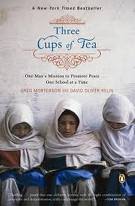
August's Featured Book of the Month is Three Cups of Tea: One Man's Mission to Promote Peace...One School at a Time. It's the inspiring true story of Greg Mortenson and his campaign to build schools in some of the most dangerous and remote areas of Pakistan and Afghanistan.

In 1993 Mortenson was descending from his failed attempt to reach the peak of K2. Exhausted and disoriented, he wandered away from his group into the most desolate reaches of northern Pakistan. Alone, without food, water, or shelter he stumbled into an impoverished Pakistani village where he was nursed back to health.

While recovering he observed the village’s 84 children sitting outdoors, scratching their lessons in the dirt with sticks. The village was so poor that it could not afford the $1-a-day salary to hire a teacher. When he left the village, he promised that he would return to build them a school. From that rash, heartfelt promise grew one of the most incredible humanitarian campaigns of our time.

Visit your local branch to check out a copy of the book and for more information, read the transcript of the Washington Post's online chat with Greg Mortenson.

After you're read the book, get your free tickets to see Greg Mortenson at the Cintas Center on September 29 at 7pm. A limited number of tickets are available at the Main Library and Green Township and Madeira branches starting on August 2. Tickets are availble on a first-come, first-served basis with a limit of two tickets per person. For more information about the event, visit
Xavier University's website.

Friday, July 23, 2010

Let’s Discuss Sweetness at the Bottom of the Pie!

Here are some discussion questions for you to think about. Please share what you thought about the book! Hope you’ve enjoyed this book as much as I have.

With her high level of knowledge, her erudition and her self-reliance, Flavia hardly seems your typical eleven-year-old girl. Or does she? Discuss Flavia and her personality, and how her character drives this novel. Can you think of other books that have used a similar protagonist?

With her excessive interest in poisons and revenge, it’s no surprise that Flavia is fascinated, not scared, as she watches the stranger die in her garden. In your view, is her dark matter-of-factness more refreshing or disturbing?

Flavia reminds us often about Harriet, the mother she never knew, and has many keepsakes that help her imagine what she was like. Do you think the real Harriet would have fit into Flavia’s mold?

Flavia’s distance from her father, the Colonel, is obvious, yet she loves him all the same. Does their relationship change over the course of the novel in a lasting way? Would Flavia want it to?

Like any scientist. Flavia expects her world to obey certain rules, and seems to be thrown off kilter when surprises occur. How much does she rely on the predictability of those around her, like her father and her sisters, in order to pursue her own interests (like solving the murder)?

Discussion questions are from the book’s publisher Random House.

Tuesday, July 13, 2010

About Alan Bradley


Born in Toronto, Alan Bradley grew up with an education in electronic engineering. He worked at many radio and television stations and was a Director of Television Engineering in Saskatoon, SK, before he started writing during his early retirement. He is the author of many short stories, children’s stories, newspaper columns, and the memoir the Shoebox Bible. Bradley became involved in the Saskatoon writing community by becoming the first President of the Saskatoon Writers and a founding member of the Saskatchewan Writers Guild. His short story Meet Miss Mullen, received the Saskatchewan Writers Guild Award for Children’s Literature. Bradley was one of the founding members of the Casebook of Saskatoon, which is a society that studies Sherlock Holmes. Here, he met Dr. William A.S. Sarjeant, which led to the collaboration of their book Ms. Holmes of Baker Street, which theorizes that the famous detective could have been a woman. Most recently, Bradley has won the Crime Writers’ Association Debut Dagger Award for the Sweetness at the Bottom of the Pie. He has written five more in the series, where Flavia is the main character.

The author lives in Malta, with his wife Shirley and two calculating cats.

Check out his website for more information on the author and the Flavia de Luce series.

Wednesday, June 30, 2010

About The Sweetness at the Bottom of the Pie

The July Featured Book of the Month, the Sweetness at the Bottom of the Pie, is unlike most detective stories, being told from the perspective of an eleven year old girl who has a passion for poison! Flavia de Luce is a chemistry loving, bicycle riding, spirited and intelligent girl who stumbles upon peculiar events. Set in the 1950s, Flavia starts out her summer in an English village fighting with her two older sisters and brewing dangerous potions in her secret laboratory. Suddenly, life takes an unusual turn when a dead bird appears on their doorstep with a bright orange stamp on its beak. A strange red-headed man has an argument with her father and the next morning Flavia discovers the unknown man dying in their cucumber patch. Young girls would normally be frightened of a murder committed outside their own home, but Flavia’s interest burns with curiosity. “I wish I could say I was afraid, but I wasn’t. Quite the contrary. This was by far the most interesting thing that had ever happened to me in my entire life.” The summer starts to look very promising to Flavia and she is determined to solve this murky mystery!

Alan Bradley presents a young heroine who is an engaging, quick-witted, and fearless sleuth. Winner of the 2007 Crime Writers’ Association Debut Dagger, this inventive detective story is a delightful read with many twists and turns.

Awards:
Winner of the 2007 - Crime Writers’ Association Debut Dagger
Winner of the 2009 - Arthur Ellis Award for Best First Novel

Read an excerpt from NPR’s website

Check out the international versions of the book covers!


Created with Admarket's flickrSLiDR.

Here is a trailer to promote the book:

Tuesday, June 22, 2010

Discussion questions for Last Child in the Woods

We’re sure that Last Child in the Woods has given you a lot to ponder! (By a pond, perhaps?!) But in case not, here are some questions to think about, wherever you may be.
Please share your comments!

Can you compare your own childhood interactions with nature to those of a contemporary child? What are the similarities? Differences?

Can a child in an intensely urban setting easily find “a piece of nature” (without going to a park)? Where might they find it?

What’s more real for today’s children, technology or nature? Or is there a balance?

What experience in nature have you had that you wish every child could have? Why?

Tuesday, June 15, 2010

About Richard Louv

Richard Louv is an American journalist credited with identifying the phenomenon and coining the now-common phrase known as “nature deficit disorder.” He has written for major American newpapers like The New York Times and Washington Post and was a columnist for the San Diego Union–Tribune from 1984 – 1987. He is the author of seven books, arguably the most famous being Last Child in the Woods.

To review recent columns and commentaries, visit Mr. Louv’s blog, Fieldnotes from the Future, a component of the Children’s Nature Network of which he is chairman and co-founder. And be sure to check out Louv’s official website for information about his books and the latest news in the Children and Nature movement.

Louv is married to Kathy Frederick Louv and is father to Jason, 28 and Matthew, 22.

Tuesday, June 1, 2010

About Last Child in the Woods


Find your favorite tree stump and pull out your copy of June's Featured Book of the Month, Richard Louv's Last Child in the Woods: Saving Our Children From Nature-Deficit Disorder.

The author contends that today's children, unlike children a mere thirty years ago, are dangerously deprived of exposure to nature, the thing that inspires, teaches and gives us comfort. Gated communities, obsession with electronic technology, and changing standards in education are just some things that distract our children from their "eighth intelligence" and creativity.

Louv includes some great quotes and stories from the likes of Eleanor Roosevelt, Beatrix Potter, Mark Twain, and Thomas Edison that credit their early curiosities to time spent in wood and field. And it’s certainly interesting to ponder what role the natural world played in our own childhoods and how it shaped our adult pursuits.

Is nature inaccessible to today’s children?
Can we go back to nature? How?
Or is nature even important anymore?

The author, a former journalist, offers up research from environmentalists and educators that lays bare the reasons for reconnecting, rebuilding, rethinking, and redesigning our relationships with the outdoors.

There are suggested actions to take and activities to pursue with kids. Who knows, maybe we can go back to Walden! What do you think?

Written by Bob

Thursday, May 27, 2010

Thursday, May 20, 2010

Discussion Questions for The Lost City of Z*

I hope you're enjoying The Lost City of Z! Without giving too much away, here are a few discussion questions for you to consider. Post a comment about them or just tell us what you think about the book--we would love to hear from you!

How would you describe Fawcett? A rational man of science? A victim of his own obsession? What were his most admirable qualities and what aspects of his character were most troubling?

Does the interweaving of Grann's own story of his search for the truth about what happened to Fawcett add to or detract from The Lost City of Z?

What does The Lost City of Z reveal about the nature of obsession? Why were people fascinated by Fawcett in 1925? Why are people still fascinated by him 85 years after his disappearance?

Does The Lost City of Z remind you of any other books you have read, either fiction or non-fiction?

*Discussion questions courtesy of litlovers.com, murmur.com, and me!

Tuesday, May 11, 2010

About David Grann

David Grann is a staff writer for The New Yorker magazine and the author of The Lost City of Z: A Tale of Deadly Obsession in the Amazon (2009) and his latest book, The Detective and Sherlock Holmes: Tales of Murder, Madness, and Obsession (2010).

Prior to joining The New Yorker, Grann was a senior editior and contributor at The New Republic, and has also written for the New York Times Magazine, The Atlantic, the Washington Post, the Boston Globe, and the Wall Street Journal.

Grann's stories have appeared in several anthologies, including The Best American Crime Writing (2004, 2005, and 2009) and The Best American Sports Writing (2003 and 2006). He lives in New York with his wife and two children.

Be sure to read this interesting interview with David Grann about The Lost City of Z, or listen to his NPR interview on Talk of the Nation!

Friday, April 30, 2010

About The Lost City of Z

Our May Featured Book of the Month is a true adventure story! In The Lost City of Z: A Tale of Deadly Obsession in the Amazon by David Grann, renowned British explorer Percy Fawcett embarked on an expedition deep into the Amazon jungle in 1925, vowing to make archaeological history by locating an undiscovered ancient civilization he called the Lost City of Z. He was never heard from again ...

While researching a story, The New Yorker writer David Grann stumbled on a reference to Fawcett's role in inspiring Sir Arthur Conan Doyle's 1912 novel, The Lost World. Intrigued, Grann began reading as much as possible about Fawcett and became fascinated by his idea of Z. Armed with information uncovered in Fawcett's private diaries and logbooks, he headed into the Amazon, determined to discover the truth about the explorer and his fatal mission--despite his utter lack of outdoorsmanship, his terrible sense of direction, and the knowledge that over 100 "Fawcett Freaks" had perished in the jungle before him ...

Did Fawcett find Z? Did Grann find Fawcett? Let's read and find out!

Next week, I'll post more information about author David Grann. And in the weeks to come, I'll post some discussion questions and a related reading booklist. In the meantime, I hope you enjoy The Lost City of Z. Your comments are always welcome!

Friday, March 19, 2010

Check Back in April....

I hope you're enjoying the On The Same Page selection, The Hunger Games. Be sure to check back on April 1 to find out which book was selected as the next Featured Book of the Month.

Monday, February 1, 2010

On The Same Page

The Featured Book of the Month program is on break during February and March to make way for The Library's On The Same Page community reading program. Check the On The Same Page website for information on the 2010 title, The Hunger Games by Suzanne Collins. Be sure to stop into your local branch to check out a copy and then discuss the book in person at one of our book discussions or online.

Thursday, January 14, 2010

Let's Get the Discussion Started!


I hope you're enjoying January's Featured Book of the Month, Farewell, My Subaru by Doug Fine. I'm sure you have lots of thoughts about the book, so let's get the discussion started!

-What do you like about the book? What don't you like?
-What steps have you taken to lead a greener lifestyle? Would you go as far as raising goats and driving a ROAT (Ridiculously Oversized American Truck) powered by vegetable oil?
-Do you think it's really possible to live a green lifestyle without giving up your modern conveniences? Why or why not?

Friday, January 8, 2010

About Doug Fine


After being raised on Dominoes Pizza and Brady Bunch re-runs, Doug Fine’s method of journalistic investigation was to strap on a backpack and travel to five continents; to the nooks where the world’s monied media venues weren’t sending their people.

As a young freelancer, Fine reported in this manner for the Washington Post, Salon, U.S. News and World Report, Sierra, Wired, Outside, National Public Radio, and other venues from little-visited jungle war zones like Burma, Rwanda, Laos, Guatemala and Tajikistan. He became a world-class adventure writer and investigative journalist, writing culturally-insightful and funny dispatches. One of these, about democracy efforts in Burma, was read into the U.S. Congressional Record.

During this time, his 20s, Fine recognized that he lived on an actual planet, and that he felt most alive while in wild ecosystems. Following this impulse in contradiction to all the suburban values with which he was raised (which can be summarized as, “if you’re not going to be a doctor, you can at least be a lawyer”), he moved to extreme rural Alaska to see if a former suburbanite could survive. Happiness and self-awareness were the goals. This resulted in his award-nominated first book, Not Really An Alaskan Mountain Man, which is now in its third printing.

Realizing that living in sync with his ecosystem is indeed where his own inspiration and personal happiness reside, Fine for his second book decided to embark on a “Hypocrisy Reduction Project,” to see if he could truly live a sustainable lifestyle, rather than borrowing from Babylon to live in an ecological Zion. He moved to a beautifully-obscure valley in Southern New Mexico to write Farewell, My Subaru, to quite simply see if a Digital Age Human can live without Petroleum but without giving up any of his Digital Age Comforts. His conclusion? He can, once he figures out how to keep the coyotes from eating his chickens, his solar panels from electrocuting him, and his vegetable oil truck exhaust from giving him a bad case of the munchies (it smells like Kung Pao chicken).

Be sure to visit your local branch and check out a copy of Farewell, My Subaru and mark your calendar for Doug Fine's visit to the Main Library on February 6.

Friday, January 1, 2010

About Farewell, My Subaru


Is your New Year's resolution to live a more green lifestyle? If it is (or even if it isn't) stop into your local branch and check out a copy of January's Featured Book of the Month, Farewell, My Subaru: An Epic Adventure in Local Living by Doug Fine. The book details Fine's attempts to live locally and reduce his dependence on oil, all while keeping his modern conveniences. In the author's words,

"This ia a book of carbon-neutral carnage, about my attempts to kick oil while still living like an American. Farewell, My Subaru is the account of everything that can go wrong (and then right) when a regular guy tries to get oil out of his life. It details, among other embarrassing (but, my editor insists, inspiring) realities: coyotes eating my chickens, my near-death due to clumsiness during solar panel installation, and my suffering from Extreme Munchies thanks to the exhaust of my new carbon-neutral, vegetable oil-powered R.O.A.T. (Ridiculously Oversized American Truck). Hence the title of the book – I had to ditch the ol’ reliable Subaru in favor of a diesel. But for all the mishaps, I have reduced my electric bill by 80% and no longer need gas stations to drive. All while keeping my Netflix, my Internet, my fridge, washing machine, and most of all, my booming subwoofers."

For more information about the book visit Doug Fine's website. Be sure to check out your copy today, check back here to discuss the book, then visit the Main Library on February 6 at 2pm to meet Doug Fine.

Tuesday, December 15, 2009

Discussion Questions for Under the Banner of Heaven

I hope you're enjoying our December Featured Book of the Month, Under the Banner of Heaven: A Story of Violent Faith by Jon Krakauer. Some insightful comments about the book have already been posted, so here are a few discussion questions for you to consider. Join the conversation or add your own thoughts...we'd love to hear from you!

Did you like the book? Why or why not?

Given the nature of--and the motive for--the murders of Brenda Lafferty and her child, should Ron Lafferty be considered mentally ill? Or, as Krakauer states in his book, "If Ron wasn't insane--or at least no more "insane" than anyone else who believes in God--what was he? Why had the Lafferty brothers' religious beliefs turned them into ruthless killers?"

How would you expect maintream and fundamentalist Mormons to react to Krakauer's book?